Case study, E-commerce
An industrial store organised by the problem, not the product.
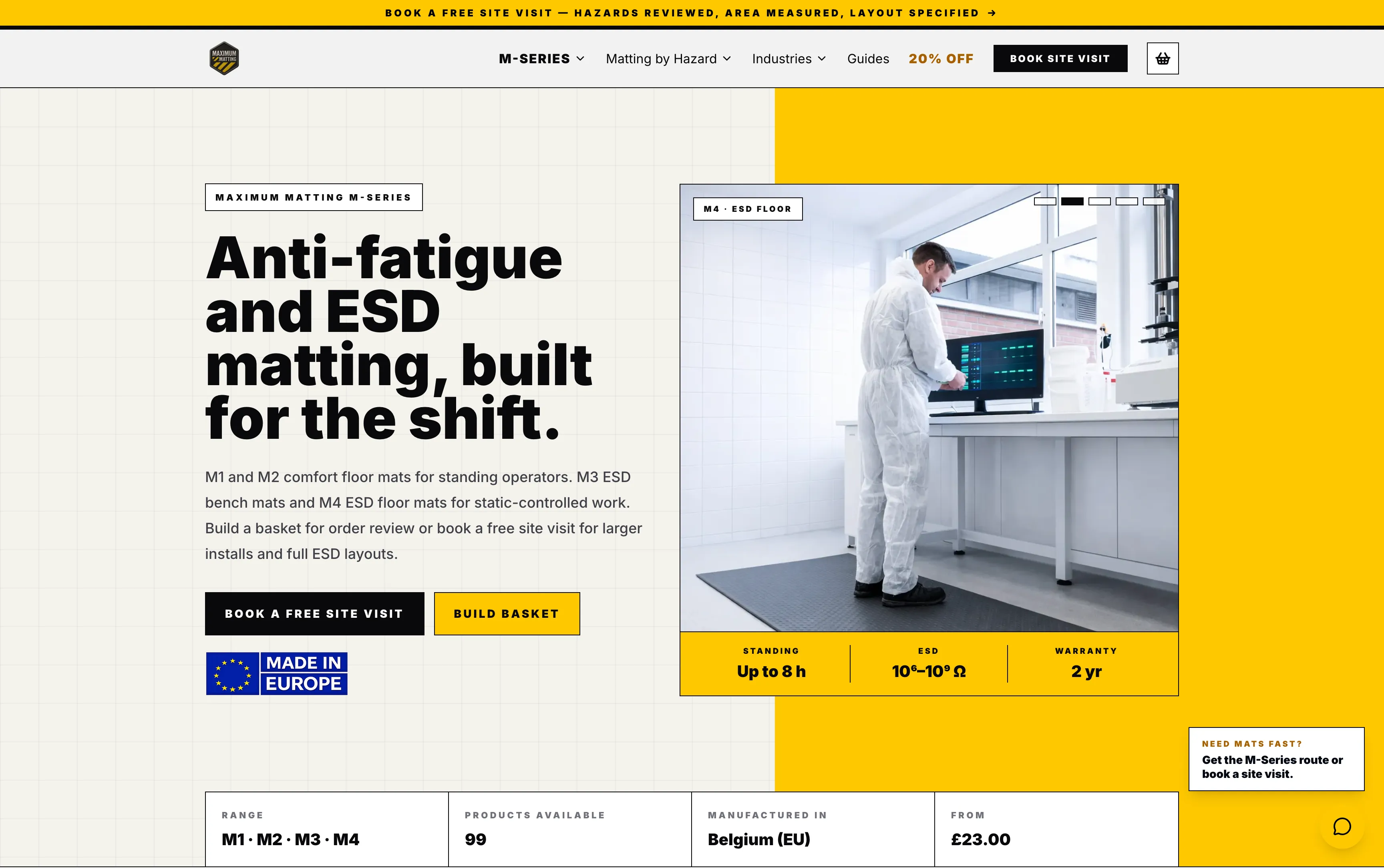
Maximum Matting sells anti-fatigue, anti-slip, ESD and hot-work matting to UK industry. Buyers arrive describing a hazard, not a product code, so the store is built around the hazard.
- Maximum Matting
- New build
- E-commerce
The brief
The brief.
Industrial matting is a considered B2B purchase with two very different buyers. One knows exactly which mat they want and needs to order it without friction. The other has a floor problem, a safety audit, or a shift complaining about standing all day, and has no idea what the product is called. A conventional category tree serves the first buyer and abandons the second.
The site also had to carry two purchase routes at once: straightforward online ordering for stock items, and a specified, measured quote for larger installations where a site visit is the correct next step.
Scope
What we built.
- 01
Hazard-first navigation
Entry routes by the risk being solved, anti-slip, anti-fatigue, ESD and anti-static, hot works and welding, alongside the conventional product tree.
- 02
Full product catalogue
The stocked range including modular tiles, workstation kits, antimicrobial mats, edging and accessories, and the M-Series line.
- 03
Sector pages
Industry-specific guidance so buyers in a given environment can see what applies to them without translating from generic copy.
- 04
Buyer guides and knowledge base
Comparison and specification content covering matting types, selection and installation, structured to support both research and search.
- 05
Tile and area planner
A planning tool for working out layout and quantity before ordering, reducing the guesswork on modular installs.
- 06
Site visit route
A parallel path for larger installs where hazards are reviewed and the area measured, ending in an installable specification.
Decisions
Build decisions.
- 01
Two front doors, one catalogue
Hazard-first entry and product-first entry both resolve to the same products. The buyer picks the mental model; the store does the translation.
- 02
Guides as part of the store
The knowledge base is not a detached blog. It sits inside the buying journey and links directly to the products it discusses.
- 03
A tool instead of a form
The area planner answers 'how many do I need' on the page. It removes the most common pre-order support question before it is asked.
What it's built with
The stack behind it.
- Astro
- Ecommerce architecture
- Technical SEO
- Content and guides system
We build regularly in this space, see how we approach manufacturing & industrial .
Capabilities used
Want the same for your business?
- Astro development Marketing and content websites built on Astro for speed and search.
- Websites & platforms Fast websites and platforms that integrate with the systems behind them.
- Full websites Complete multi-page business websites, engineered on Astro for speed and search.
- Content & blogs A content-led website built around the questions your customers actually ask.
More work
Other projects.


Start a project
Want work like this for your business?
Tell us what you're trying to move and we'll shape the right engagement, a landing page, a full build, or a redesign of what you already have. You'll hear back from Jake directly.
Three questions · about a minute
See the work